The French Anthropologist Claude Lévi-Strauss once said, “The scientist is not a person who gives the right answers, he's one who asks the right questions.” Still, as scientists we often have to answer questions as well…usually at the end of our talks when we’re tired and simply wishing for a nap, or perhaps a beer.
Speaking about Science...the blog about how to communicate scientific concepts to the public, and to other scientists, and about why we should care.
About Me
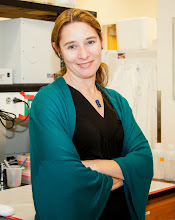
- Allison Coffin, PhD, DTM
- I'm an assistant professor of neuroscience at Washington State University in Vancouver, where I use tiny zebrafish (the size of an eyelash!) as a model system to study human hearing loss and how we can prevent it. I'm also a long-time Toastmaster and I teach communication workshops. This blog represents the merging of my two passions - science and communication, which has really become one central passion - the science of communication. There's a revolution in science right now...the idea that we scientists should sometimes leave the lab and talk about what we do, and why we do it, to real people. This blog looks at why we should do this, and how to actually talk about science with non-scientists (and with each other!). Portions of this blog are also featured on Qualia, the AAAS MemberCenter blog site.
Sunday, April 15, 2012
Monday, January 30, 2012
Three cheers for the honey badger?
Last week I introduced the Science Cheerleaders as one way to promote scientific careers and science literacy. Today I offer up the viral youtube video about the honey badger as another option for science communication outreach. For the three people that haven’t yet stumbled upon honey badger hysteria (you can even get a t-shirt, and the book version is due out soon!), here’s a short synopsis.
Saturday, January 21, 2012
Give me an “S”!
Most scientists are more comfortable in a lab coat than a sport coat, let alone a mini-skirt. Today I want to introduce a group of (mostly) women that promote science to the public with shiny outfits and pom-poms. Meet the Science Cheerleaders!
![]() |
| Picture courtesy of sciencecheerleader.com |
These women are scientists, science educators, health professionals, and scientists-in-training. Beyond their love of science, they share another common passion - cheerleading! All are current or former cheerleaders at the college or professional level. Their mission is to promote science and technology careers for girls, and to help educate the population at large about the important of science and technology in their lives.
As a science communicator, I think this is brilliant! What better way to attract attention to science, and raise girls’ interest in science careers, than with sparkle! What about you? Do you think the Science Cheerleaders (or other like them) help science? Why or why not?
Sunday, January 15, 2012
Smells like…science?
Don’t just tell your audience-let them see (and hear, smell, and taste) the experience themselves! In a recent Toastmaster Magazine article, author Colleen Plimpton implored us as speakers to use rich sensory language in our presentations and to engage multiple sensory modalities by offering up things for our audience to see, smell, maybe even taste. Ms. Plimpton uses these techniques for her lectures on gardening and garden design, describing the vibrant flowers and musty soil of her trade.
Wednesday, January 4, 2012
Great Seattle public science series!
Looking for great examples of effective public communication of science? Or perhaps you just want to learn something new without delving into a specialty scientific journal? Either way, check out the Engage Science Seminar Series, offered this year as part of the Seattle Science lecture series.
Looking for more tips and thoughts on science communication? I promise to return to my usual non-regular blogging schedule soon!
Monday, October 31, 2011
Trick, Treat, or Talk
On a fine Halloween day, why not sprinkle a little Halloween spirit into your talk? Dr. Gwenn Garden of the University of Washington did just that, giving us a little light-heartedness at the beginning of her neuroscience seminar today. Dr. Garden studies glia - the cells in our brains that neurons can’t live without. Rather than using a laser pointer to show us features on her slides, Gwenn used her fairy wand-today she was the glia fairy! Her opening slides also included analogies to candy corn-anyone hungry for some Halloween candy?
Monday, October 24, 2011
A renewed call to action
I know I said I was going “off the air” until I moved, but I heard a terrific conversation this morning on the local NPR station and couldn’t help sharing a few thoughts…with so much going on right now I sure have plenty of thoughts to share!
Today’s Weekday guest was bioethics professor Dr. Jonathan Moreno from the University of Pennsylvania. Dr. Moreno and host Steve Scher talked about serious ethical issues in experimental biology, from stem cells and regenerative medicine to personal genome sequencing. For those in the Seattle area, Dr. Moreno will be speaking at the University of Washington on 10/25/11 at 3:30 PM.
While the conversation itself was fascinating, what really resonated for me (and perhaps some of you) was the repeated call for scientists to leave the lab sometimes and engage the public in honest dialog about what we do and why it is important - how has science transformed our world? These conversations are critical when we work on potential hot-button issues such as stem cells or genetic engineering, but insight into how science works and how the world will benefit is important at all levels.
Not a new message, but still an important one. If we want the public to understand and support science, it’s up to us to explain it clearly!
Subscribe to:
Posts (Atom)


