About Me

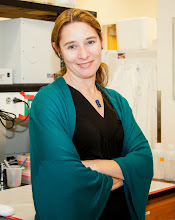
My photo
I'm an assistant professor of neuroscience at Washington State University in Vancouver, where I use tiny zebrafish (the size of an eyelash!) as a model system to study human hearing loss and how we can prevent it. I'm also a long-time Toastmaster and I teach communication workshops. This blog represents the merging of my two passions - science and communication, which has really become one central passion - the science of communication. There's a revolution in science right now...the idea that we scientists should sometimes leave the lab and talk about what we do, and why we do it, to real people. This blog looks at why we should do this, and how to actually talk about science with non-scientists (and with each other!). Portions of this blog are also featured on Qualia, the AAAS MemberCenter blog site.

Thursday, April 11, 2013

Authenticity: just be you

By Janine Castro, PhD

-->
www.ratrodbikes.com
I’ve been teaching a number of public speaking workshops for scientists lately and have stumbled across an interesting dilemma.  As an instructor, I make a diligent effort to model the behavior that I am trying to teach, because, after all, public speaking is a performance art. My goal, however, is not for students to emulate my style, but to create a style all their own. Demonstrating the “right” way to present invariably leads to the “wrong” way to present. I have come to the conclusion that there really is no correct presentation style, but there is your correct style.

Tuesday, March 19, 2013

Tracking your progress?


-->
I just attended a talk where the speaker had a progress bar at the bottom of each slide.  The bar nicely showed where we were at in the talk, and how long until it was done (or so I thought-some of his “single slides” were really multiple slides built up!). As an audience member, I appreciated the progress bar, but I also found it distracting…when the speaker was explaining some of the more difficult concepts, I found myself staring at the bar, rather than trying to follow his explanation.
     What do you think?  Have you ever tried using a progress bar or some kind of tracker that the audience can see?  Is this device helpful to the audience, or a barrier to communication? I look forward to hearing from you.

Sunday, March 3, 2013

Speaking of Executive Presence


By Janine Castro
What is executive presence, other than a very trendy term that has infiltrated into the business lexicon? The best, short definition that I’ve run across is “a strong personal brand” (Susan Bates).  Executive presence is hard to break into components because it is more than a sum of its parts; however, there is general agreement that it is a culmination of appearance, confidence, and voice, but above all, it is authenticity – the quality of being trustworthy and reliable.

Friday, January 11, 2013

Science communication: It’s kids’ stuff


Why is the sky blue?  Why is water wet? Kids ask the really tough questions, questions we adults aren’t brave enough to voice anymore! To really communicate our science, and engage the next generation with real science, not just collections of facts, we need to talk to kids on their level. If we can explain our science to a kid and hold their interest while we teach, we’ve succeeded in our communication efforts.

From Wikimedia Commons
Enter Alan Alda (remember M.A.S.H.?) and the Center for Communicating Science at Stony Brook University. Mr. Alda offers up the Flame Challenge, an international contest where scientists submit their best answers to a question posed by a kid. Last year’s question was “What is a flame?”. This year brings an even tougher question, “What is time?”. The kicker is in the judging - answers are judged not by scientists, but by 11-year-olds, and they aren’t shy about offering their opinion. Talk about trial by fire! (or perhaps, by flame)

If you want more help building skills before subjecting yourself to the Flame Challenge, or to any group of scientifically curious kids (or adults!), check out the course offerings by the Center for Communicating Science. They have a great line-up of science communication courses and workshops and even offer a certificate program. Check out the improv workshop…looks like fun!

Tuesday, January 1, 2013

Learning Style = Presentation Style?

By Janine Castro, PhD

-->
Several years ago, one of my colleagues recommended that my prospective field course students take the Index of Learning Styles (ILS) Questionnaire.  Her contention was (and still is) that instructors must expand both their learning materials and delivery style to address the needs of all students … hence, the need to know my students preferred learning styles. The ILS was developed by Richard Felder and Barbara Soloman of North Carolina State University.  In a nutshell, learning preferences are evaluated on four dimensions -- active/reflective, sensing/intuitive, visual/verbal, and sequential/global. 

New Communicatalyst blogger!

I'd like to introduce Dr. Janine Castro, a geomorphologist with the US Fish and Wildlife Service and National Marine Fisheries Service in Portland, OR.  I'll post Janine's full bio soon.  Janine has several years experience teaching science communication workshops and will be a regular contributor to Communicatalyst. We are also developing a website with science communication resources and will be offering workshops.  Very exciting times-stay tuned!

Thursday, November 29, 2012

Presentation strength training


From http://www.bboyscience.com/mental-health-strength/
In my quest for eternal youth (or at least slower signs of aging!) I’ve started weight training.  All of those bicep curls and shoulder presses are starting to pay off – I can actually see muscles in my upper body.

Just as we perform exercises to help our bodies look and perform their best, we can (and should!) perform exercises to improve our speaking skills. I developed a quick set of speaking exercises to work on specific aspects of public speaking: voice volume, eye contact, body language, and removing filler words.  These exercises work well in groups of 5-10 people but can be modified for different sized groups or situations.